
Turner County Projected and Actual Release Dates
A projected date is a planning marker based on the sentence and facts known to the agency at that point. An actual release date records when custody ended in that system. The distinction matters in Turner County because the sheriff roster, GDC records, and the State Board of Pardons and Paroles each answer a different question. The Turner roster can say Status: RELEASED, but its public fields do not show a separate projected date or release time.
A pretrial detainee generally has no computed sentence-end date. Release may depend on bond being posted, a judge changing conditions, dismissal, a hold clearing, or another agency taking custody. A sentenced state prisoner can have dates calculated from the sentence, jail credit, legal eligibility, and state rules. Even then, the date in a public result may be provisional.
Note: A Turner County jail release can be followed at once by GDC, another county, federal, or immigration custody.
How to Run a Turner County Release Date Lookup
Begin with the last known custody setting, not just the arresting county. This avoids treating a county booking as though it were a state-prison sentence. Use names with dates of birth, case numbers, or agency identifiers when available because name-only matches can point to the wrong person.
- Check the Turner Sheriff current-inmates view. A current entry uses the status currently booked.
- If the person is absent, search the Inmates by Arrest Date archive. It can retain a booking with the status released.
- For a local release date or reason, call Turner County Jail at 229-567-3812 or request the booking and release record from the sheriff.
- For a state sentence, open GDC Find an Offender and compare the GDC ID, case details, location, charges, and release-date information.
- For parole timing, use the Board’s TPM lookup explanation and linked tool. Read a TPM as a review point, not a promise.
- Confirm sentence papers, bond orders, or jail credit with the Turner court that handled the case when agency dates conflict.
The Turner County released-inmate search and records paths are explained in more detail on the home page. For exact GDC verification, the agency disclaimer directs written correspondence to Inmate Records and Information, PO Box 1529, Forsyth, GA 31029.
Which Turner County Release Source Fits
No single database covers every Turner County custody path. The best source depends on whether the person remains at the county jail, entered GDC custody, reached parole review, or has already begun supervision.
| Custody question | Best source | What it can show |
|---|---|---|
| Still in Turner County Jail? | Sheriff Current Inmates | Currently booked status, arrest facts, charges, bond, court, and days in jail |
| Recently left the county jail? | Inmates by Arrest Date | Released status and booking facts, but not a separate projected date or release reason |
| Serving a Georgia state sentence? | GDC offender search | Facility location, charges, photo if available, and release-date information |
| Approaching possible parole? | Board TPM lookup | Tentative Parole Month, which is a final-review marker |
| Already released on parole? | Board parolee search | Parole begin and end dates, office, office number, and primary offense |
| Date or jail-credit dispute? | GDC counselor and court clerk | Sentence paperwork, credit records, correction steps, and certified documents |
A live roster answers a present-custody question. An archive or release record answers whether the person left that jail. A state search applies only after a Georgia corrections path exists. None of these results alone proves that the person is free from every hold or supervision term.
Georgia Release-Date Terms for Turner County Cases
Georgia agencies use several labels that can look interchangeable in a search result. Keeping the source’s own term prevents a planning date from being mistaken for a fixed discharge.
The Board states that parole-eligible people in GDC custody are considered automatically. An application is not required. Yet eligibility merely permits review. It does not compel release, and the Board notes that few people are granted parole at the first eligibility point.
Note: Use the exact label shown by GDC or the Parole Board when recording a date from a public result.
Turner County Sentences and Georgia Incentive Credits
Georgia does not provide one simple local good-time formula for all Turner County cases. O.C.G.A. 42-5-101 authorizes GDC work incentive credits for academic or vocational attainment, satisfactory work, and compliance with behavior standards. The statute supports the state framework, while GDC describes how its current Performance Incentive Credit program operates.
Under the GDC PIC program, an eligible state offender can accumulate up to 12 points and may receive 1 to 12 months off a TPM or MRD. The public pathways include case-plan progress, education or vocational improvement, and work-detail assignments. The word “may” is vital. A credit opportunity is not a guaranteed reduction.
GDC excludes important groups, including probationers, people with sentences of two years or less, life sentences, death sentences, and people serving non-parole-eligible or minimum-mandatory terms. Covered serious violent felony sentences may also be governed by serve-as-imposed restrictions. A Turner County jail detainee should not assume GDC PIC rules apply to a short local stay.
The successful GDC PIC capture below is useful because it shows the official state page behind the MRD and TPM reduction terms. It illustrates the source to consult, while the live page remains the authority for current program details.
The official Georgia Department of Corrections PIC program page shows the source used for the credit rules below.
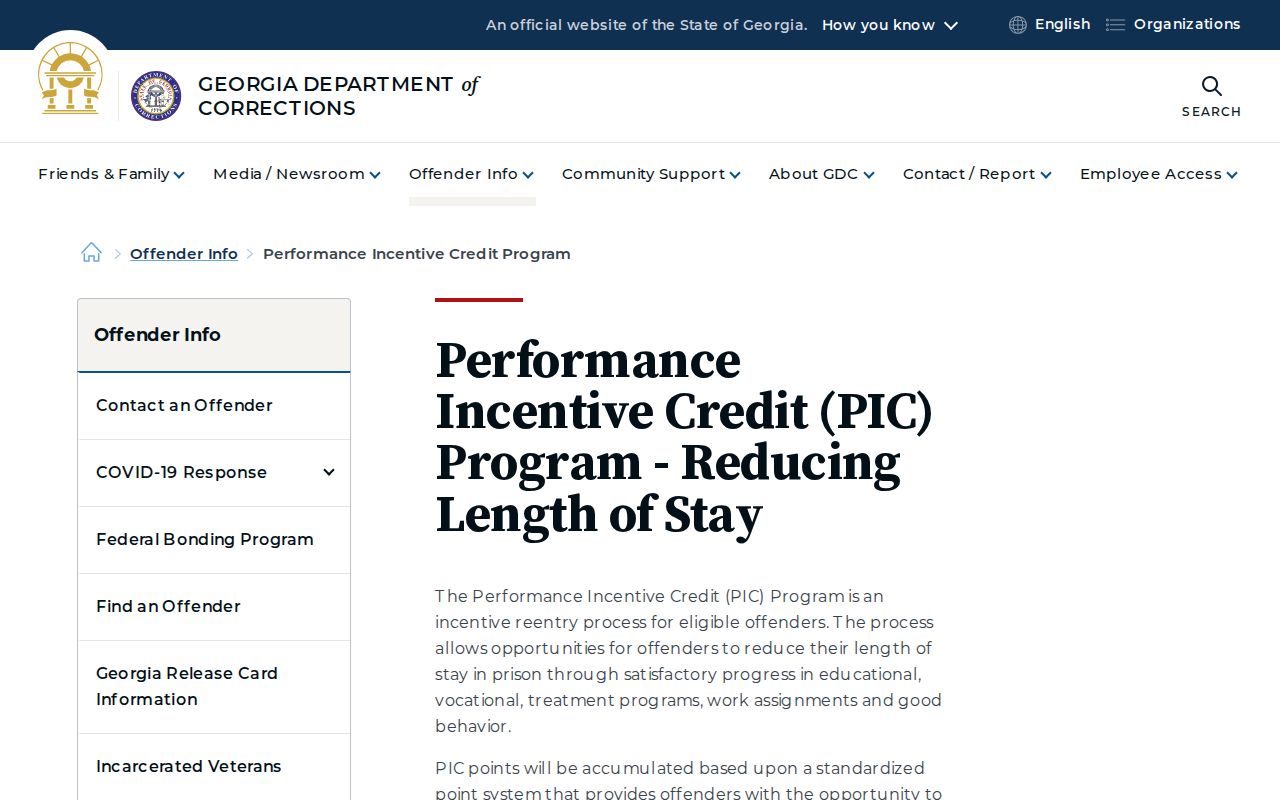
The image does not establish eligibility for a named person. Sentence type, conduct, programs, and GDC review still control the individual result.
Parole Eligibility Is Not a Turner County Release Date
O.C.G.A. 42-9-45 provides the general rule that most felony inmates become eligible for parole consideration after nine months or one-third of the sentence, whichever is greater, subject to exceptions. For misdemeanors, the cited general point is six months or one-third. These are eligibility thresholds, not scheduled exit dates.
The Board can set a future TPM, deny parole, or alter a decision before release. Final review may also depend on conduct and program completion. A person with an MRD later than a TPM should not assume the earlier month is certain. Likewise, a person who reaches statutory eligibility may remain in custody after that point.
Serious-Felony Limits on Turner County Release Dates
O.C.G.A. 17-10-6.1 controls major restrictions for serious violent felonies. The current code text states that covered sentences are served as imposed and cannot be reduced through parole, earned time, early release, work release, leave, or other sentence-reducing measures, apart from limited final-year transitional options described in law.
The Parole Board also distinguishes life-sentence timing by offense date. Its public explanation gives seven years for relevant pre-1995 serious violent felony life cases, fourteen years for the 1995 period, and thirty years for crimes on or after July 1, 2006. Non-life qualifying serious violent felony offenses committed on or after January 1, 1995 are listed as ineligible for parole consideration.
These rules show why a conviction label and offense date matter as much as the sentence length. Anyone reading a Turner County result should use the sentencing order and current agency record rather than apply a broad percentage.
Why a Turner County Release Date Changes
A date can move because the inputs or legal status change. Some factors shorten the state marker, while others delay physical release or route the person into a different custody system.
| Factor | Possible effect | Where to verify |
|---|---|---|
| PIC award or recalculation | May reduce an eligible TPM or MRD | GDC offender and records channels |
| Misconduct or unmet program condition | May postpone or cancel a parole marker | GDC and Parole Board records |
| Parole grant, denial, or revision | Can establish, remove, or move a future release plan | TPM lookup and Board information |
| Detainer or hold | May cause transfer instead of community release | Holding agency and requesting agency |
| Court order or corrected sentence | Can change the controlling term | Sentencing court and GDC records |
| County jail credit correction | Can alter time computation | GDC counselor, grievance path, and court clerk |
The Turner roster’s released status only confirms the person is no longer booked in that roster entry. It does not reveal whether a detainer caused a transfer, whether parole began, or why release occurred.
Turner RSAT Makes TPM and MRD Local
Turner County has an unusually concrete connection to Georgia release-date terminology. GDC says Turner RSAT Center in Sycamore was built in 2004 and opened in 2006 as a pre-release center for medium and minimum-security offenders with less than five years remaining on TPM or MRD. It was remissioned in 2012 as a six-month Residential Substance Abuse Treatment program.
That history shows why TPM and MRD appear in local Turner County research even though they are statewide measures. Turner RSAT is a GDC setting, not an extension of the Turner County Jail. A person leaving it follows a state offender or probation path, so the sheriff archive is not the right source for the date.
Note: Turner RSAT’s former pre-release mission explains the terms, but it does not make a TPM a guaranteed release date.
Correcting Turner County Jail-Credit Errors
GDC gives a defined escalation path when a state prisoner believes time is wrong or county jail credit was not applied. The inmate should first speak with a counselor and may use the grievance process. GDC also says the matter may require contact with the clerk in the county of conviction.
For a Turner County conviction, the relevant file may be with the Turner Clerk of Superior Court for a felony matter or Turner State Court for a misdemeanor matter. The clerk can provide the sentencing sheet, disposition, or related record, but GDC remains responsible for its time computation. The two sources may need to be reconciled rather than treated as substitutes.
Confirm a Turner County Release Date
For the county jail, call the jail and ask whether the person was released, transferred, or remains subject to a hold. For a formal answer, request the booking and release record from the Turner County Sheriff at 1301 Industrial Drive, Ashburn, GA 31714. Ask for release date and time, reason, transfer destination, and hold status when public.
For a state sentence, verify the GDC search result with Inmate Records and Information if precision matters. A custody-change notice can add timely awareness, and the VINE Inmate Check explains the Georgia notification route. VINE is an alert channel, not a certified sentence-computation record.
Finally, compare the actual release event with the court disposition and supervision record. A person may leave physical custody while remaining on parole, probation, or another agency’s hold. That layered check is the safest way to answer when a Turner County inmate will get out and whether release truly occurred.